- May 05, 2026
Bootstrap Startup Without Investors: Complete Guide
- August 05, 2026
- in Startups

Do you want to start a business but do not want to take money from investors? This is called bootstrapping. You build your company using your own money and profits. You do not give away ownership. You do not answer to anyone else. Many successful companies started this way.
Bootstrap startup without investors is becoming more common. Founders are choosing to stay independent. They want full control. They want to build at their own pace. This guide shows you exactly how to do this. You will learn from real companies that succeeded without any outside funding.
What is a Bootstrap Startup?
A bootstrap startup is a business that grows using internal money only. You use your savings. You use revenue from customers. You reinvest profits back into the business. You do not raise venture capital. You do not take loans from banks for initial growth.
This is the opposite of the VC model. Most startups you hear about raise millions from investors. They burn cash to grow fast. They often make no profit for years. Bootstrap startups are different. They focus on profitability from day one.
Read More: Top B2B Marketing Strategies to Boost Startup Growth
Why Bootstrapping Works?
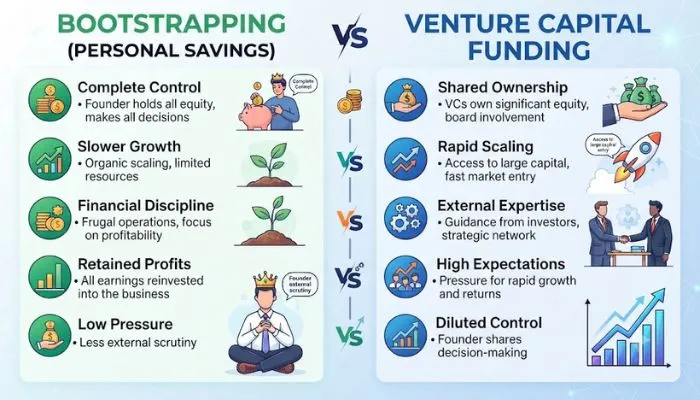
Bootstrapped companies have several advantages over funded startups.
- Higher profit margins. According to ProfitWell data, bootstrapped companies have average profit margins of 21 percent. VC-backed companies have only 10 percent . This happens because bootstrapped businesses focus on efficiency.
- Better survival rates. LinkedIn data shows bootstrapped companies have a significantly higher success rate than VC-backed ones . You do not need millions to succeed. You need a good product and paying customers.
- Full control. You make all decisions. You do not have investors telling you to grow faster or change direction. You build what you believe in.
- Customer focus. You need customers to survive. You cannot burn cash for years. This forces you to build something people actually want.
Most Profitable Bootstrapped Startup Examples
Zerodha
- Zerodha is India's largest brokerage. The company took 10 years to become a unicorn. It never raised external funding. In FY25, Zerodha made 4,237 crore in profit .
- The founders spent zero money on advertising. They built a flat-fee model when everyone else charged percentages. They built for traders, not trends. This is how to build a most profitable bootstrapped startup.
Nykaa
- Falguni Nayar started Nykaa at age 50. She quit her MD role at Kotak after 19 years. She took 9 years to list the company profitably in 2021. FY25 revenue was 7,950 crore with 24 percent growth .
- Nykaa started when people said beauty e-commerce would not work in India. The company survived website crashes, team changes, and zero traction. They stuck with it. They built for the long term.
Bonkers Corner
- Shubham Gupta started Bonkers Corner alone in 2020. He had no team and no money. Manufacturing was in-house. Orders came through Instagram DMs. The first designer was hired only one year later .
- The brand stayed bootstrapped and profitable since day one. It grew to 195 crore business with 15-16 crore net profit in FY26 . They only raised external money after appearing on Shark Tank when retail expansion needed capital.
Jar of Love
- A Hyderabad couple started this pickle business with 1,300 in cash during the COVID lockdown. They had no income. They used a friend's grandmother's chicken pickle recipe. From that initial investment, they made 4 kilograms of pickle .
- Five years later, the bootstrapped D2C brand clocked 3.3 crore in revenue at its peak. The product had natural shelf-life of one year without preservatives. They achieved a 35 percent customer repeat rate. No ad budget. Just organic Instagram and word of mouth .
GoStops
- GoStops built India's largest hostel chain from zero. They started with foreign backpackers who already understood hostels. This proved viability before educating Indian travelers. The company grew from zero to 40 hostels with 2,500 beds .
- The founders used a smart approach. They chose locations where young travelers wanted to be. They tracked exactly what remained after rent, salaries, and electricity. When COVID crashed real estate prices, they expanded aggressively .
How to Find Bootstrapped Companies?
If you want to find bootstrapped companies, look in the right places.
- Indie Hackers is the best directory. Users post revenue milestones and product launches. You can search by revenue range and industry .
- Twitter is where founders talk about traction. Search phrases like "hit $50K MRR" or "bootstrapped to X revenue." Founders who hit milestones are often evaluating new tools .
- Product Hunt indexes SaaS launches. Most launches include founder names and contact details. Filter by category and launch date. Founders who launched recently are in growth mode .
- MicroAcquire lists SaaS businesses for sale. This helps find founders scaling their operations .
- GitHub shows technical founders building open-source tools. Look for repos with recent commits that link to commercial products .
Bootstrapped founders are more transparent about revenue than VC-backed companies. They have no investors to manage. Use this to your advantage .
How to Bootstrap Your Own Startup
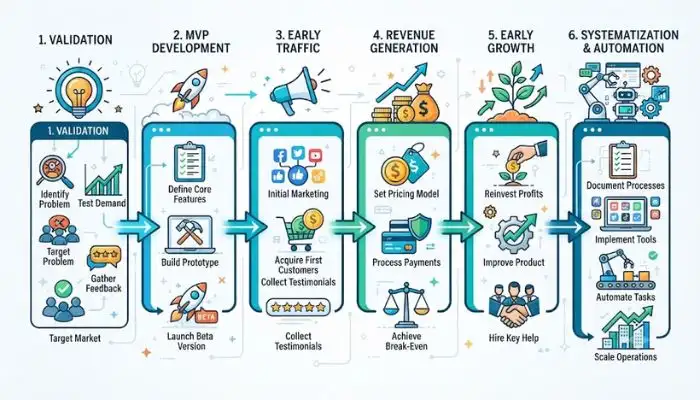
Step 1: Validate Your Idea Without Spending Money
- Do not build a full product first. This wastes time and money. Talk to potential customers. Ask if they have the problem you are solving. Ask if they would pay for a solution.
- Many founders make the mistake of building something nobody wants. Marie Martens from Tally says: "You build an MVP, get it into the hands of users as fast as possible and only then do you start growing your team" .
Step 2: Use Your Own Money First
- Use savings from your job. Use any income you have. This forces you to be careful with spending. You only spend on what matters.
- Johann Sathianathen funded his software projects through his full-time job at Cisco. He did not spend his salary on lifestyle upgrades. He funneled it into building a lean team to launch products .
Step 3: Get the Product to Users Fast
- Your MVP does not need to be perfect. It needs to be usable. Get feedback immediately.
- Tally started by sharing the product with friends and family. Then they did cold outreach through Product Hunt. They found users who upvoted similar products and reached out personally. This helped them reach 1,500 users in six months .
Step 4: Keep the Team Lean
- Do not hire too early. Small teams move faster. They cost less.
- Tally's core team is four full-timers: two cofounders and two engineers. They also have part-time support staff. They hire only when realy needed .
- Chatbase scaled to $6 million ARR with only 14 people . Hire senior generalists who can do multiple things. You do not need separate front-end and back-end roles in a small team.
Step 5: Prioritize Ruthlessly
- Bootstrapped founders must focus on what gets results. Say no to most requests.
- Marie Martens keeps her calendar clear to focus on the product. She says no to 95 percent of requests in her inbox. Her default response to coffee meetings is no .
Step 6: Use AI to Save Time
- AI tools let small teams do more work. Use them for marketing, content creation, customer support, and data analysis.
- Chatbase grew by 20 percent after evolving from an AI chatbot to a full AI agent platform. They listened to customers. They built what customers actually needed .
Step 7: Spend on Marketing Only After You Earn
- Chatbase had no ad budget until they hit $50K monthly recurring revenue. Everything before that came from organic traffic and community engagement .
- Once you see clear signals on what messaging works, then spend on ads. Not before.
Step 8: Automate Everything That Does Not Need Humans
Ask these questions about your tasks:
- Is this repetitive?
- Does it require human judgment?
- Will automating it increase speed without lowering quality?
Automate content creation, social media posts, email sequences, and data tracking. This lets you scale without adding people.
You May Also Read: What are the best startup marketing strategies for 2026?
Bootstrap Business Examples That Work
The pattern is clear. Most profitable bootstrapped startups solve real problems. They do not chase what looks exciting. They build execution systems.
Zerodha built a low-margin, high-volume model. Nykaa focused on omnichannel strategy with 60 percent business from Tier 2+ cities. Razorpay prioritized expansion over short-term profits for 7 years. They solved boring problems that people actually pay for .
None of these companies had one viral moment. They built through thousands of unglamorous decisions over many years .
FAQs
1. What is a bootstrap startup?
A bootstrap startup is a business built using personal savings and revenue from customers. You do not take money from investors. You reinvest profits back into the business. You stay in full control.
2. Is bootstrapping better than raising VC money?
Bootstrapping gives you higher profit margins, better survival rates, and full control. VC money lets you grow faster but takes ownership and control. Bootstrapped companies have 21 percent average profit margins compared to 10 percent for VC-backed ones.
3. Can you build a profitable bootstrap startup in India?
Yes. Zerodha makes 4,237 crore profit with no external funding. Nykaa has 7,950 crore revenue. Bonkers Corner grew to 195 crore from zero. Jar of Love started with 1,300 and reached 3.3 crore revenue. Many successful Indian companies started this way.
4. How to find bootstrapped companies?
Look on Indie Hackers, Twitter (search for revenue milestones), Product Hunt, MicroAcquire, and GitHub. Bootstrapped founders are more transparent about revenue than VC-backed companies because they have no investors to manage.
5. What is the most profitable bootstrapped startup in India?
Zerodha is one of the most profitable. It made 4,237 crore profit in FY25 with zero external funding. The company spent zero on advertising and took 10 years to become a unicorn on its own terms.
you may also like



- April 07, 2026
Step-by-Step Fitness Success Plan for Men Beginners...

- March 10, 2026
How to Become an Entrepreneur With No Experience Easy...

- March 10, 2026
Top B2B Marketing Strategies to Boost Startup Growth...

- February 24, 2026